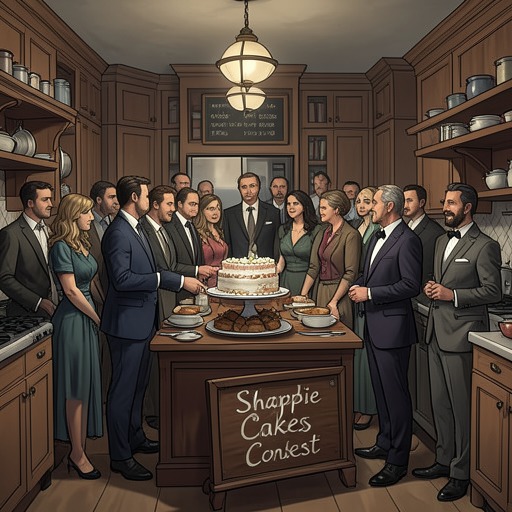
Sharpie Cake Company
Blind Willow, Sleeping WomanThe Sharpie Cake Company is the confectionery firm behind a contest to develop a new product based on Sharpies, a traditional national confection whose sales are falling. The company’s effort to combine an inherited identity with contemporary tastes leads it to hand the final decision to the Sharpie Crows, whose authority is treated as familiar inside the company but comes as a surprise to the entrant.
History and the Need for New Ideas
At the contest’s opening, the company president offers a history that traces Sharpies to an origin story from the eighth century and claims that a poem about them appears in the Kokinshu imperial anthology of 905. The speech presents the confection as carrying a long national tradition, though its account is described as dubious. The company’s ceremonial emphasis on antiquity establishes the heritage it seeks to preserve.
The managing director then explains the call for new products in the language of growth and adaptation. Beneath that polished appeal, the practical problem is direct: Sharpie sales are dropping, and the company needs ideas from younger people because the existing taste seems old-fashioned. The contest therefore asks entrants to modernize the confection without severing its connection to the product the company already makes.
The Product Competition
The Rules for Submission require contestants to create a confection based on Sharpies and deliver it to the company one month later. The prize is two million yen. For the narrator, that sum could make marriage and a move to a new apartment possible, giving the company’s contest a personal stake beyond recognition or culinary experimentation.
The narrator decides to enter, makes two dozen new Sharpie Cakes, and delivers them to the company on the due date. One month later, the company calls the narrator back to its offices. The managing director reports that staff have received the submission well, especially younger employees, while some older employees argue that it is not a Sharpie Cake at all. The difference of opinion exposes the contest’s central tension: an innovation may satisfy the call for new ideas yet challenge the boundaries of the traditional product.
The Crows as Final Judges
Unable to resolve the disagreement among its employees, the board of directors leaves the decision to the Sharpie Crows. This delegation gives the crows a formal role in determining what qualifies as a Sharpie Cake, placing the company’s commercial judgment in the hands of an unusual authority.
The company treats the crows’ role as established enough that the managing director is confused when the entrant asks who they are. That mismatch between institutional familiarity and the contestant’s ignorance sharpens the scene’s uncertainty: the contest rules announced a product and a prize, but not the decisive force that will judge the result. The Sharpie Cake Company’s pursuit of renewal thus culminates not in a clear internal standard, but in a judgment entrusted to the crows.